Dionysus
Culture
Dionysus
An outsider god
Associated with intoxication in all its forms, Dionysus is the god not only of grape harvests, wine and theatre, but also of revelry, excess and madness. He embodies a paradox – the power that grounds civilisation, and the chaos that threatens to consume it.
As the son of Zeus and the mortal Semele, Dionysus holds a unique position in the Greek pantheon – an outsider deity whose place among the Twelve Olympians varies across ancient accounts. And with good reason: Dionysus is the god of the margins. He is half-mortal. And almost always elsewhere, travelling the world to spread the art of viticulture. He also symbolises intoxication, excess and madness. As a result, his cult offers a religious experience in total contrast with the highly structured and codified rituals through which Zeus, Athena and Apollo are honoured. Dionysus offers liberation from social constraints: during his festivals, rigid hierarchies dissolve, wild abandon is embraced and masks allow worshippers to shed their identities.
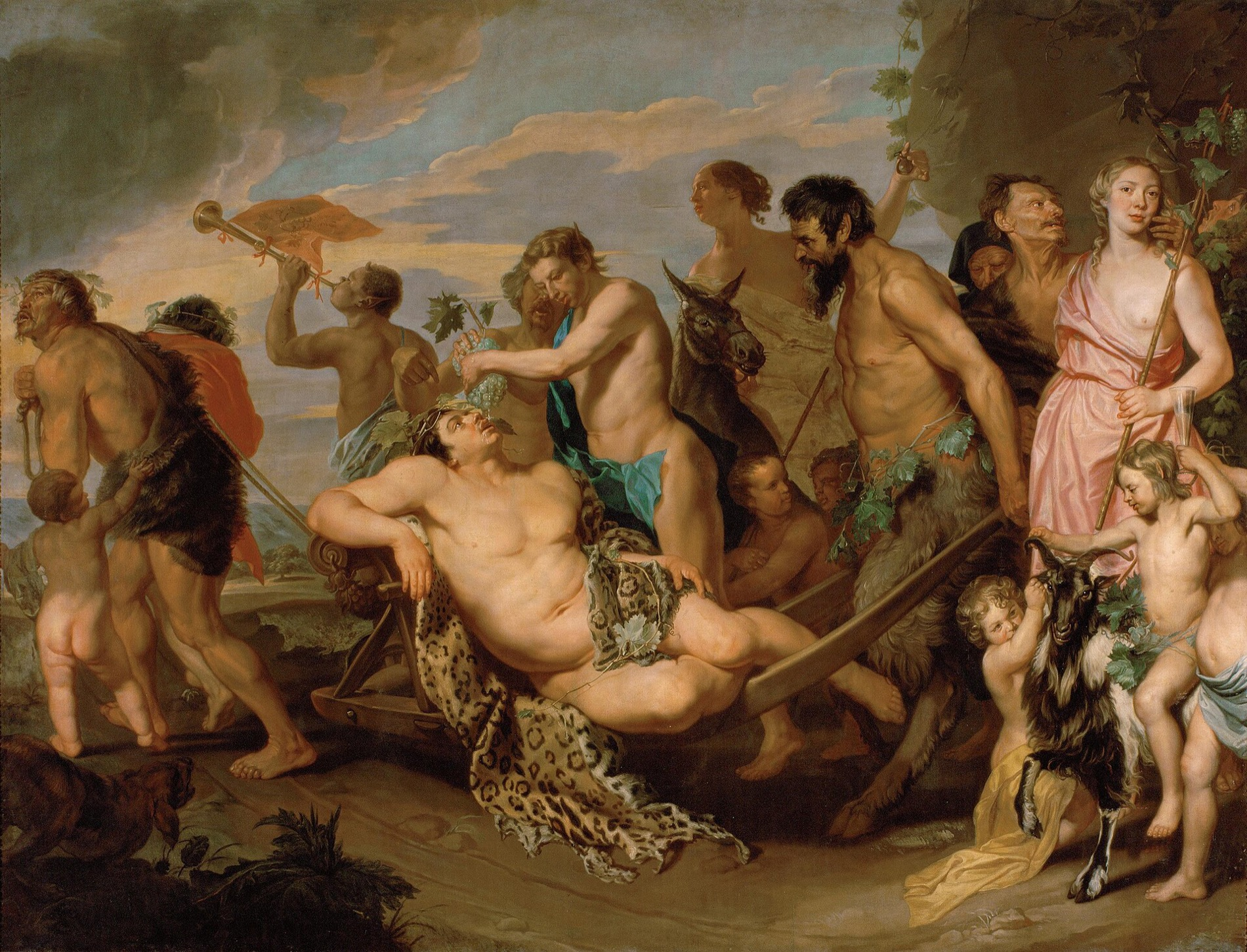 'The triumph of Bacchus' by Michaelina Wautier, 1655–1659, Vienna Museum of Art History
To understand this outsider god, we must first look back at his origins.
Born in Thebes, the illegitimate child was relentlessly hunted from infancy by Hera, the lawful wife of the lord of Olympus. To escape her wrath, he was placed in the care of nymphs residing in the mountains of Nysa (whose exact location remains unknown today) – giving rise to one of the suggested etymologies of his name: Zeus (Dio) of Nysa (Nysos).
It was there that he grew up and learned how to cultivate grapes and make wine.
But Hera’s fury showed no sign of abating. Striking him down in her wrath, she afflicted him with madness – forcing the young god into a long, wandering exile. He embarked on a nomadic lifestyle, travelling through Greece and Phrygia (in the west of modern-day Turkey), where he encountered the Great Goddess Cybele – the personification of wild nature, fertility and the earth – who purified him and bestowed upon him her ‘mysteries’, in other words, her sacred rites. Although he was cured of his madness, Dionysus remained a wanderer at heart. His travels continued as far as India, but he was no longer alone. Surrounding him was a retinue of Maenads (known to the Romans as Bacchantes) and Satyrs, who worshipped him in ecstatic trance. The procession brought precious wine to every city it passed through, spreading Dionysian frenzy across these lands like an epidemic. For in this cult, madness is the dark side of wine.
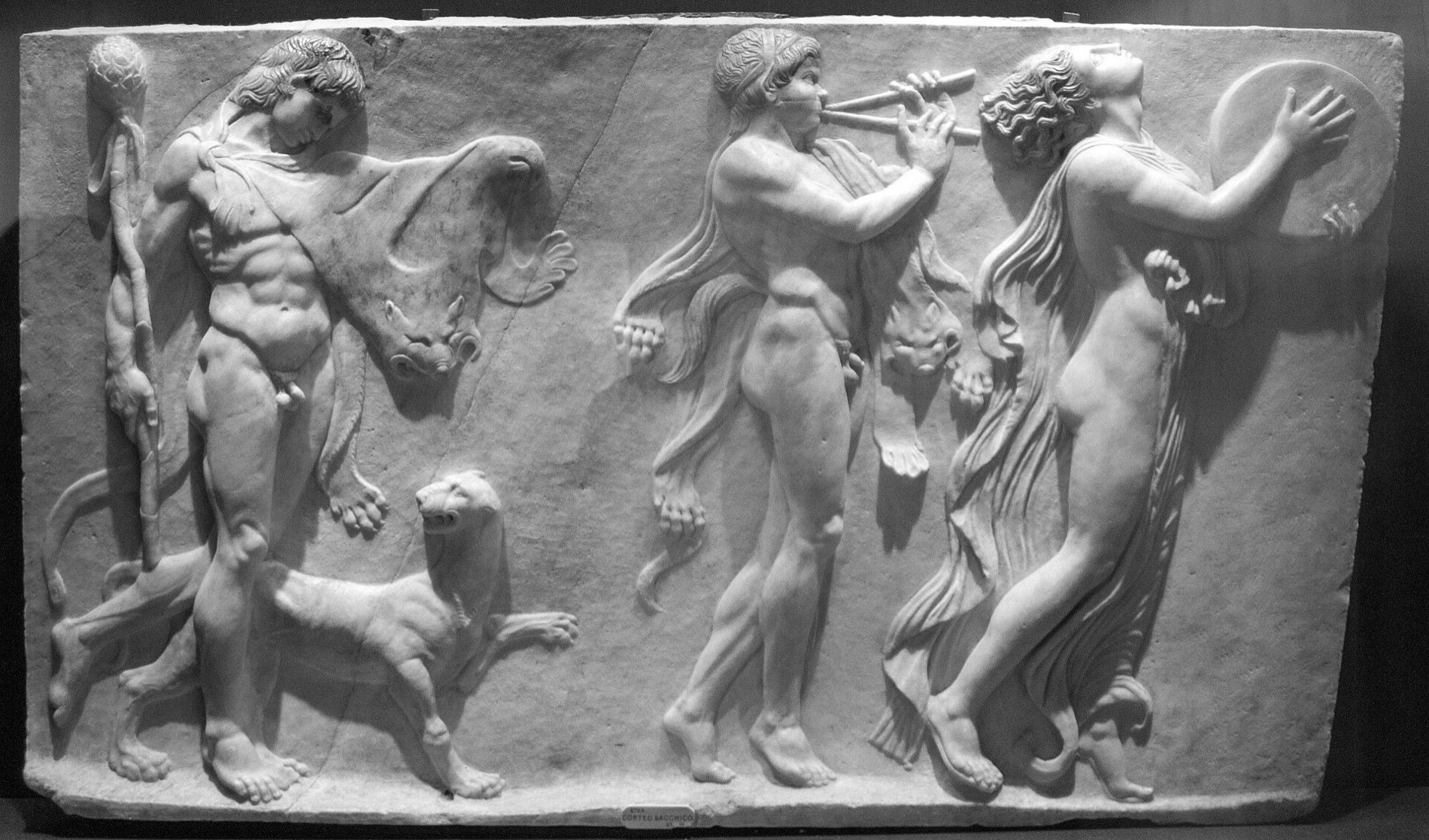 Marble relief (27 BC – 37 AD) depicting a Dionysian procession, with Dionysus accompanied by a panther on the left, a satyr in the centre and a maenad on the right. National Archaeological Museum of Naples.
This is particularly well illustrated in Euripides’ tragedy ‘The Bacchae’ (5th century BC). When Pentheus, King of Thebes, refused to allow the Dionysian cult to enter his kingdom, he was torn to pieces by a group of Bacchantes led by his own mother, Agave, who, in the throes of Dionysian delirium, had mistaken him for a wild beast. She only realised the horror of what she had done once she regained her senses. A similar fate tended to befall all those who rejected the god of wine’s teachings. Though the stories of Dionysus vary, one thing never changes: the gift of wine is tied to violence and misunderstanding. The myth thus highlights the dual nature of wine, which can grant humanity access to cosmic forces or reduce them to a primitive state, depending on how it is consumed.
In ancient Greece, this god was worshipped publicly during festivals known as the Great Dionysias. It was here, between the 6th and 5th centuries BCE, that institutionalised theatre was born – a discipline over which Dionysus also reigned. To stage the episodes of Dionysus’s life, role-play and the use of masks first emerged. In this way, theatre offered a structured framework for collective catharsis, preventing citizens from falling into uncontrolled trances during these festivals.
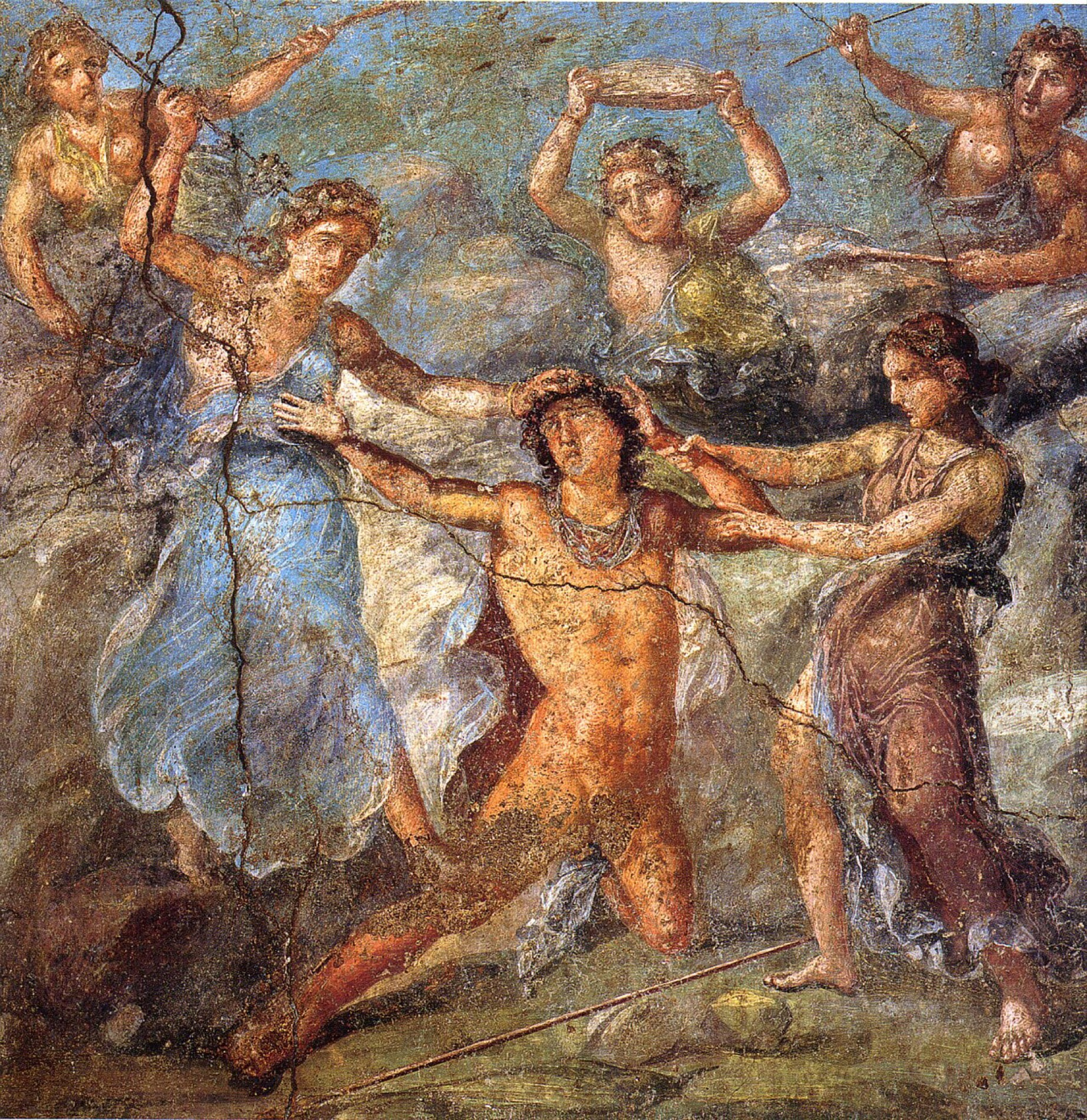 A Roman fresco from the House of the Vettii in Pompeii depicting Pentheus being torn to pieces by the Maenads.
In Rome, where Dionysus was worshipped under the name of Bacchus, his cult found expression in the Bacchanalia – nocturnal, secret rites overseen by priestesses known as Bacchantes. These festivals, which were subsequently extended to men, became increasingly frequent and allegedly devolved into subversive ceremonies marked by unrestrained drunkenness, trance states, orgies and animal sacrifice. Following reports of these alleged excesses, the Dionysian cult, which was perceived as a threat to state policy, was severely suppressed by the Roman Senate in 186 BC. Fading gradually over time, the cult ultimately vanished with the Christianisation of the Mediterranean world.
Text : Ambre Allart
Read more